
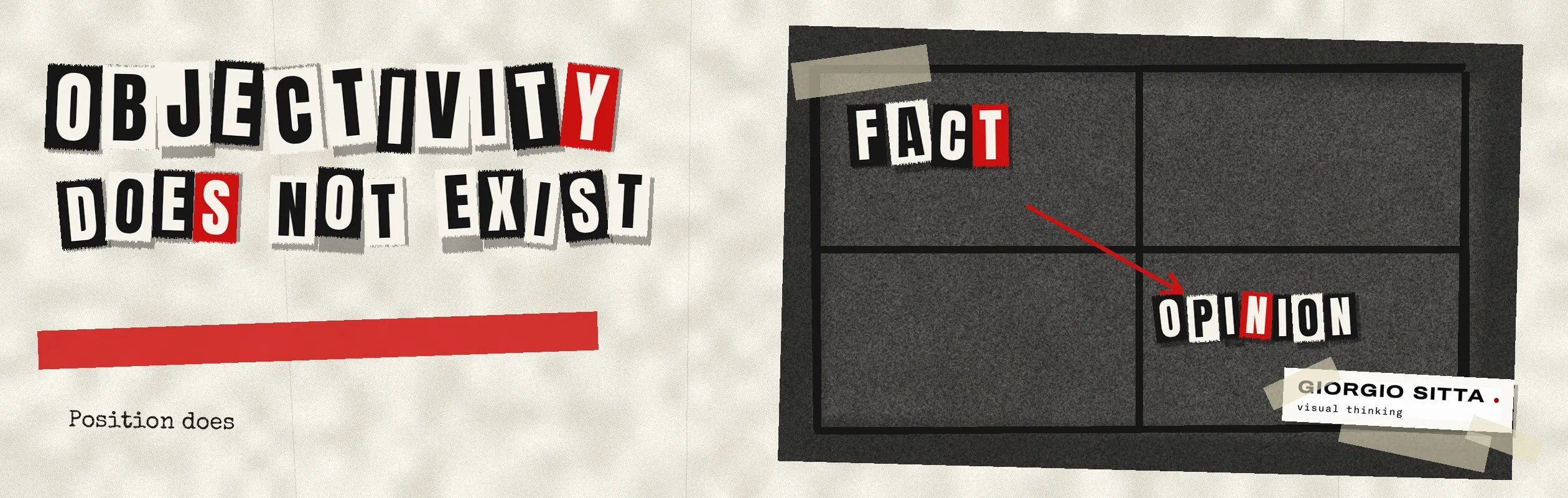
OBJECTIVITY DOES NOT EXIST, POSITION DOES
From direct cinema to the case of Kevin Carter, why every account of facts has a point of view and why it is better to declare it.
The Bang Bang Club (2010), official trailer in English, Lionsgate Canada.
An organization that tells its own story through a documentary, a reportage or a visual report often asks for two things at once: that the story be objective and that it be effective. Put like that, the two requests literally come to blows. Anyone who produces an image chooses where to stand, what to frame, how to frame it and what to leave out.
The history of documentary is, in essence, the story of how this choice was first hidden, then acknowledged and finally claimed.
THE WINDOW AND THE EDIT
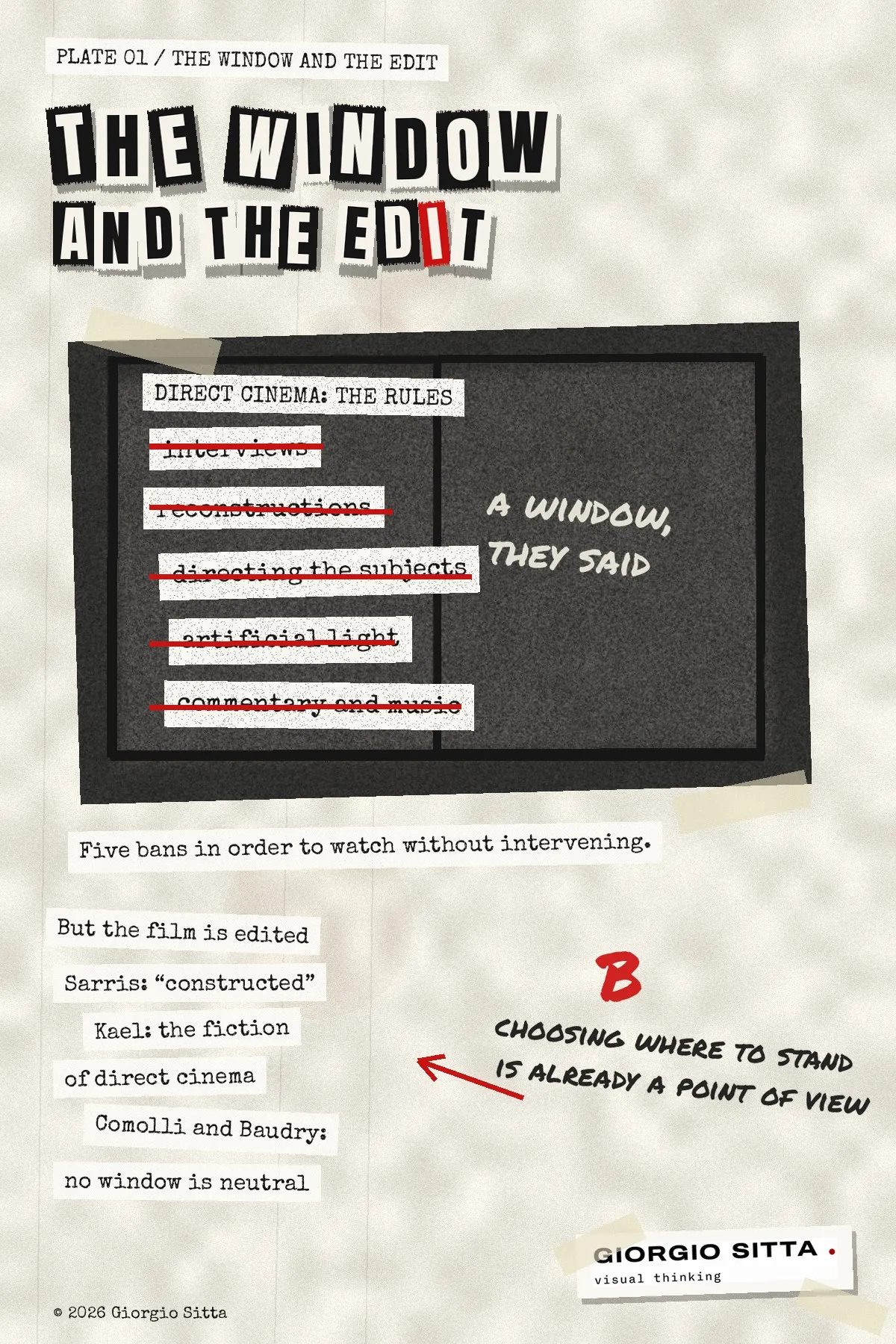
American direct cinema of the Sixties, which D. A. Pennebaker was part of, gave itself precise rules. According to Senses of Cinema, it ruled out interviews, reconstructions, directions to the subjects, artificial light, commentary and added music. Pennebaker said that nothing in Dont Look Back had been set up for the film. He compared it to a window you peek through.
The same article recalls the objections, though. Andrew Sarris called it a “constructed” documentary. Pauline Kael denounced the fiction of direct cinema. Jean-Louis Comolli and Jean-Louis Baudry challenged the idea that cinema could be a neutral window. The film, in fact, is carefully edited. The opening sequence, with Dylan holding up the cue cards of “Subterranean Homesick Blues”, has a declared artificiality. Whoever chooses where to stand with the camera has already taken a point of view.
FACT AND OPINION
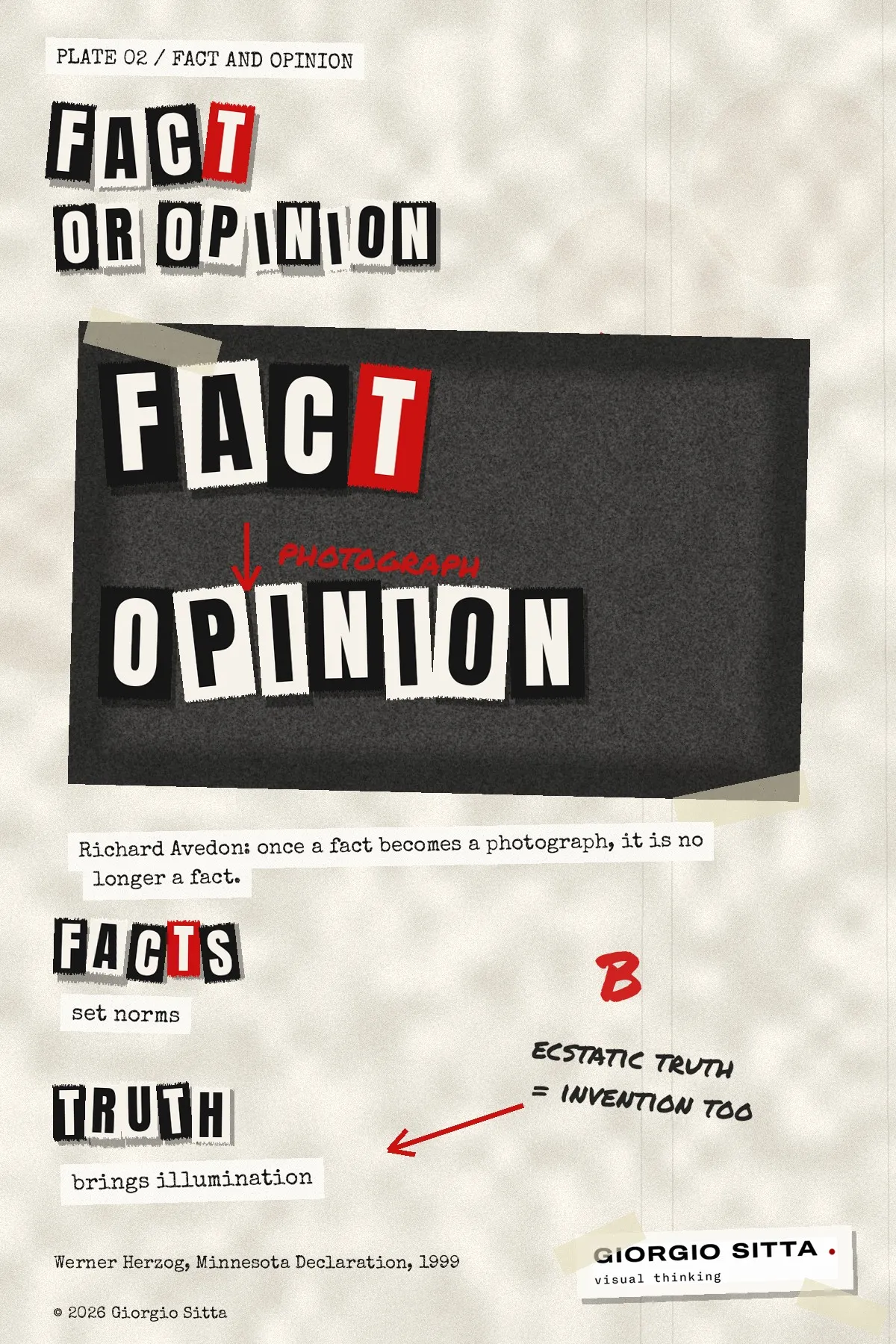
A sentence by Richard Avedon, reported in the press kit of the Fondation Henri Cartier-Bresson for the exhibition In the American West (2025), says that the moment an emotion or a fact is turned into a photograph it is no longer a fact, but an opinion. He is not talking about documentary, yet he describes its limit without beating around the bush.
Stella Bruzzi, in her book New Documentary (Routledge, second edition 2006), treats documentary as a practice based on performance and not only as an act of observation. The publisher’s text presents this approach as a way of getting past long-standing debates about the genre.
HERZOG: THE FACT IS NOT ENOUGH
A more extreme position is Werner Herzog’s. In the “Minnesota Declaration”, read at the Walker Art Center on 30 April 1999 and summarized by Roger Ebert, he argues that cinéma vérité reaches only a superficial truth, the truth of accountants. It confuses, he says, facts with truth. Facts create norms, while truth creates illumination. A deeper, “ecstatic” truth can be reached through invention and stylization as well. Herzog compares vérité filmmakers to tourists who photograph the ruins of facts.
You do not have to share the thesis (and I do) to grasp the practical consequence. Even those who give up invention choose and edit. Even those who claim to seek the truth construct it or, at the very least, interpret it. The point is not whether an author has a position, but whether they declare it.
WITNESS OR PARTICIPANT: THE CASE OF KEVIN CARTER
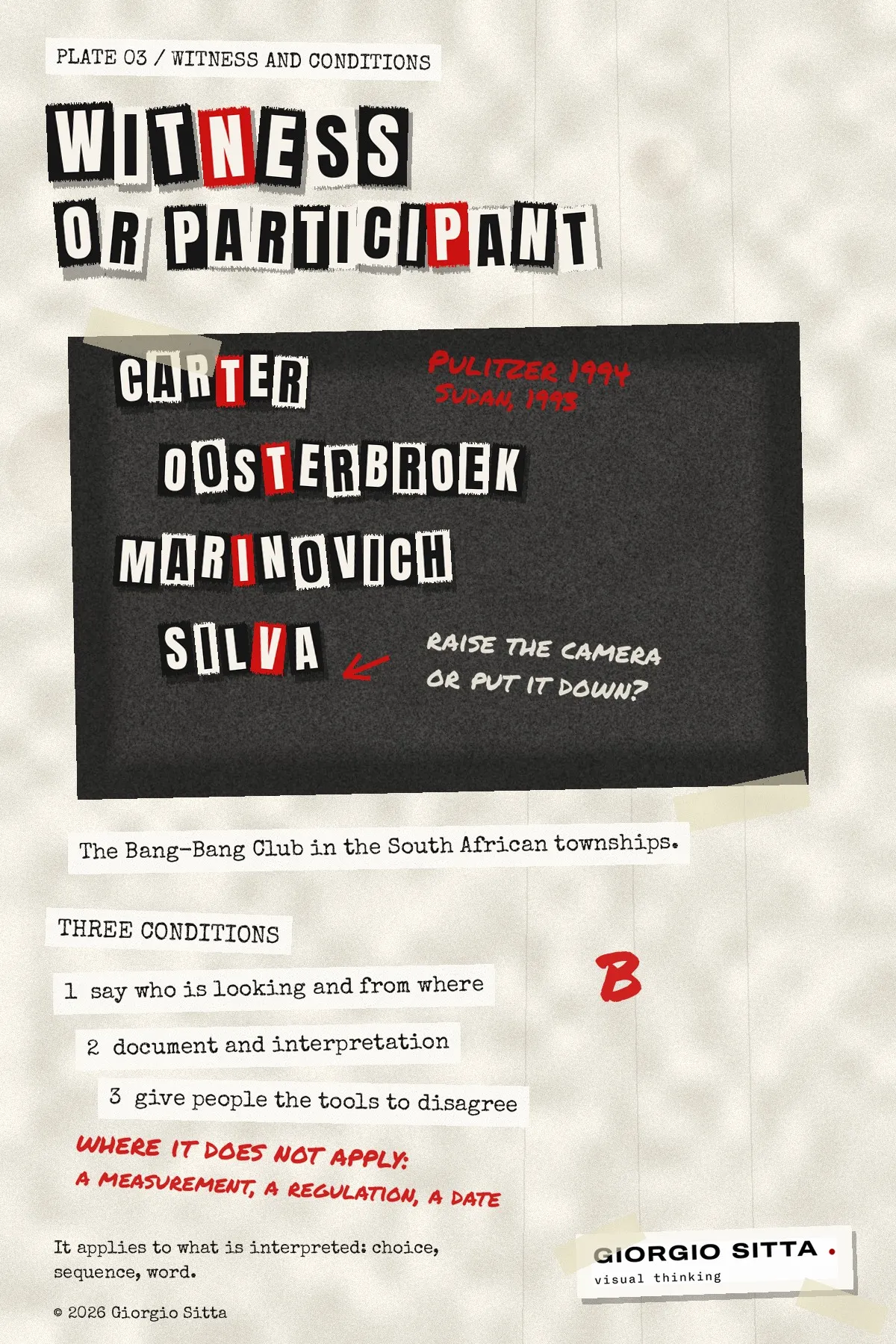
Up to here the author’s position has been a matter of style and honesty. With Kevin Carter it becomes a terrible matter of conscience. Carter belonged to the Bang-Bang Club, the group of South African photographers who, between the late Eighties and the early Nineties, documented the violence in the townships during the last years of apartheid. With him were Ken Oosterbroek, Greg Marinovich and João Silva.
In 1993 Carter photographed a child in Sudan, weakened by hunger, with a vulture nearby. The image won him the 1994 Pulitzer Prize for Feature Photography and a flood of criticism. According to Time‘s review of the Bang-Bang Club book, Carter admitted that he had not helped the child and that he sat under a tree and cried after taking the shot. The director Dan Krauss, who made an Oscar-nominated documentary about him, observes that many were very quick to see him as a cold opportunist, without trying to understand the situation of someone facing such suffering, which in itself also carries the terrible burden of the duty to document what happens.
And if you are wondering what I would have done… well, I certainly would not have won the Pulitzer.
The rest is brief and harsh. On 18 April 1994 Oosterbroek was killed in Thokoza and Marinovich was seriously wounded, something Carter learned about by radio. Carter died by suicide in July of the same year, aged 33, about three months after the Pulitzer. Krauss does not point to a single cause, but simply recalls the criticism of the photograph and the grief for his friend. The sources I have read do not support a simpler explanation than this.
What the case shows, and this is my own reasoning and not a thesis of the sources, is that the dilemma between bearing witness and intervening has no neutral solution and, probably, no solution at all. Whoever photographs is already choosing, whether to raise the camera or put it down, whether to stay in the scene or leave it. Declaring your position does not erase the weight of that choice, but it at least removes the alibi of the window and shows whoever is looking that behind the image there is a person, with a limit and a responsibility.
WHAT A STORY NEEDS IN ORDER NOT TO PRETEND TO BE NEUTRAL
From these cases we can draw three conditions. They are my own reasoning, not a thesis of the filmmakers cited.
The first is to say who is looking and from where. A visual report that declares its point of view is more credible than one that presents itself as a mirror. Mirrors, as a rule, are hung by someone.
The second is to distinguish the document from the interpretation. An archive image, a measured data point and a testimony remain documents. Editing, sequence and caption are interpretation and must be presented as such.
The third is to give the audience the tools to disagree. A story that names its sources, the choices made and what was left out allows viewers not to trust it blindly. It is the condition for being believed.
WHERE IT DOES NOT APPLY
Where a verifiable datum exists, such as a measurement, a regulation or a date, the author’s position does not change the fact and declaring it is pointless. The argument applies to what is interpreted, that is, choice, sequence and word, not to what is measured.
IN BRIEF
- Direct cinema ruled out interviews, reconstructions, directions to the subjects, added lights and music, yet its films remain edited works.
- For Avedon, a photograph is an opinion, not a fact.
- For Herzog, facts are not enough and truth is also reached through invention and stylization.
- The case of Kevin Carter, of the Bang-Bang Club, shows that the dilemma between bearing witness and intervening has no neutral solution.
- A story is more credible when it declares its point of view, its choices and what it has left out.
REFERENCES
- Senses of Cinema, article on Dont Look Back: rules of direct cinema, criticisms by Sarris, Kael, Comolli and Baudry.
- Fondation Henri Cartier-Bresson, press kit “Richard Avedon: In the American West” (2025): Avedon’s sentence.
- Routledge, page for Stella Bruzzi’s New Documentary: the thesis of documentary as performance.
- Roger Ebert, “Herzog’s Minnesota Declaration: Defining Ecstatic Truth”: summary of the Declaration.
- Walker Art Center, “Minnesota Declaration: Truth and Fact in Documentary Cinema” (1999): text of the Declaration.
- Mail & Guardian, “Oscar for film on Kevin Carter” (3 February 2006): Dan Krauss’s documentary and its Oscar nomination for Best Documentary Short.
- South African History Online, page on Kevin Carter’s death: members of the Bang-Bang Club, the Pulitzer, 18 April 1994.
- Time, review of The Bang-Bang Club (2000): the photograph, Carter’s admission, his death.
- NPR, “A Pulitzer-Winning Photographer’s Suicide” (2 March 2006): interview with Dan Krauss.
RECOMMENDED LISTENING
- Joe Cuba Sextet, Bang! Bang! (on the soundtrack of The Bang Bang Club)
- Bob Dylan, Subterranean Homesick Blues
- Hugh Masekela, Soweto Blues
THREE ARTISTS
- Werner Herzog, filmmaker: Walker Art Center
- D. A. Pennebaker, filmmaker: Pennebaker Hegedus Films
- The Bang-Bang Club (Kevin Carter, Ken Oosterbroek, Greg Marinovich and João Silva), photographers: South African History Online
THREE FILMS
- Dont Look Back (D. A. Pennebaker, 1967): Criterion Channel
- Salesman (Albert and David Maysles, Charlotte Zwerin, 1969): Criterion
- The Bang Bang Club (Steven Silver, 2010): official trailer, Lionsgate Canada
THREE BOOKS
- Stella Bruzzi, New Documentary (Routledge, 2006): Routledge
- Erik Barnouw, Documentary: A History of the Non-Fiction Film (Oxford University Press, 1993): Oxford Academic
- Greg Marinovich and João Silva, The Bang-Bang Club: Snapshots from a Hidden War (Basic Books, 2000): Hachette Book Group
Newsletter.
Ricevi ogni nuovo articolo per email.
Get every new article by email. New articles are also available in English.
Newsletter. Chi si iscrive alla newsletter fornisce il proprio indirizzo email per ricevere i nuovi articoli del blog. L'iscrizione e l'invio sono gestiti da Jetpack (Automattic Inc.), che tratta i dati come responsabile del trattamento. È possibile cancellarsi in qualsiasi momento con il link presente in ogni email. Dettagli nella privacy policy.
Newsletter. By subscribing, you provide your email address to receive new blog articles. Subscription and delivery are handled by Jetpack (Automattic Inc.), which processes the data as data processor. You can unsubscribe at any time using the link included in every email. Details in the privacy policy.