
FROM THE HERO’S JOURNEY TO THE ANTI-HERO’S JOURNEY
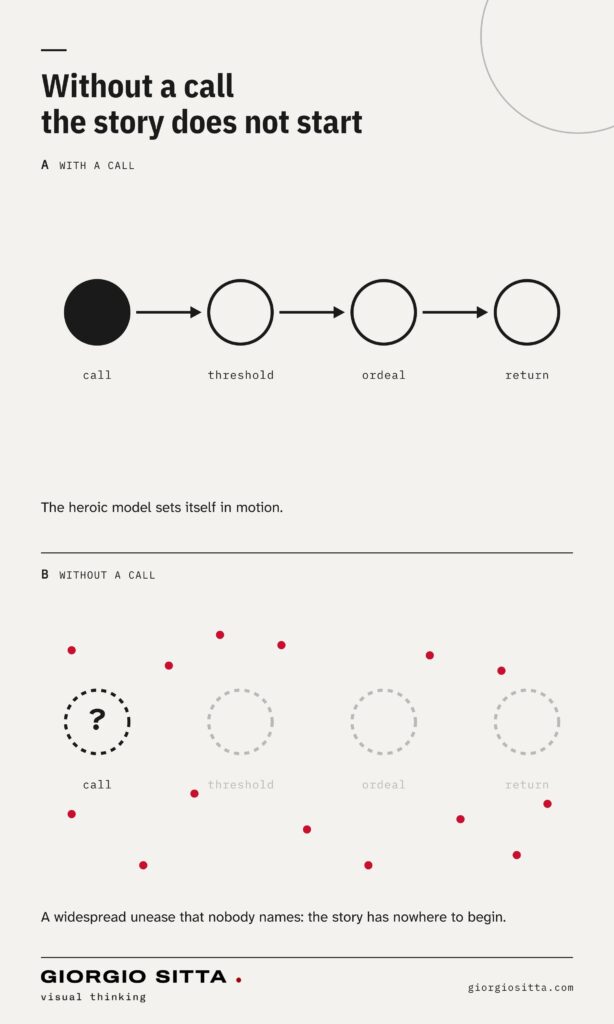
For years I built articles, books and narratives for my clients on the same architecture: a call, a threshold, an ordeal, a return. The Hero’s Journey worked in the most technical sense of the word, because it held the reader, gave a rhythm and closed the accounts. Then, in the nineties, it began to sound false to me.
A MODEL BORN FOR WRITING
My first applications of the Hero’s Journey were editorial. For articles, texts and books the model codified in 1992 by Christopher Vogler, in a handbook for those who write fiction and film, offered a ready-made, recognisable and effective structure. There was no reason to question it as long as it held the stories I had to tell.
THE NINETIES AND THE INTERNALISED CRISIS
The doubt arrived together with a personal, professional and human growth, in a decade when everything became “post” something else and genres blended into “crossover”. Grunge, more than other movements, questioned the imposed models. In place of the emphatic call it told of an internalised crisis, less spectacular and truer.
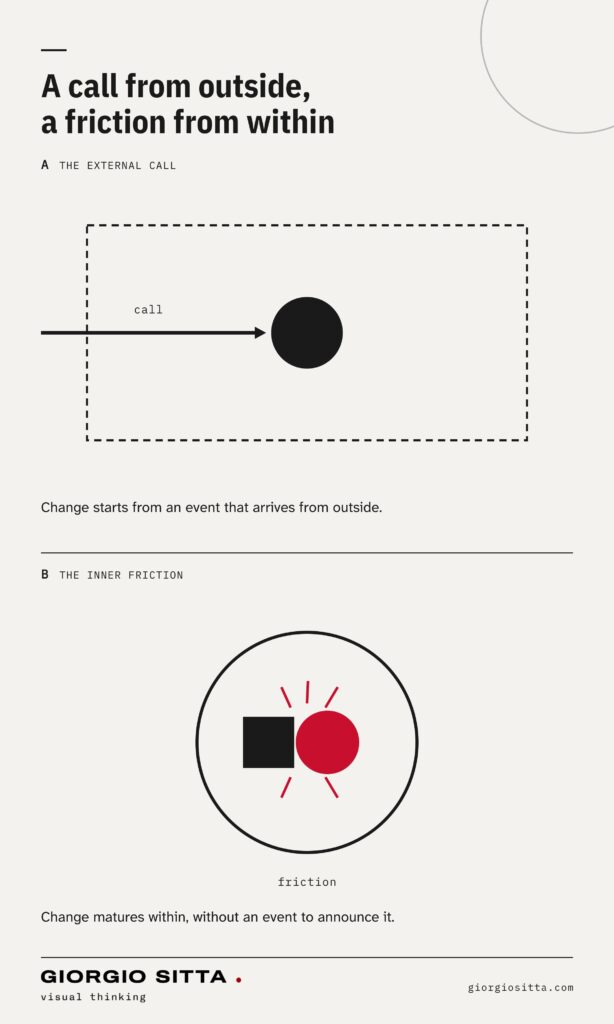
In that sensibility I recognised something the Hero’s Journey did not foresee: a change that does not start from an external event, but from a friction that matures within.
THE UNEASE COMPANIES DID NOT NAME
In my work with companies the problem took another form. At times the need to change seemed imposed from outside; at other times it was not visible at all. There was a subtle, diffuse unease that nobody identified as a need for change.
The heroic model needs a call to get moving. Without a call the story does not start, and for this reason the model had no tools to tell that unease.
A METHOD GROWN BY CORRECTIONS
The Anti-Hero’s Journey, or Il Cammino dell’Antieroe (the method, with its eight phases, is described on antieroe.com), was not born on a precise day nor from a precise project. I began to change the way I used the Hero’s Journey, one correction at a time, until what I was applying had become something else.
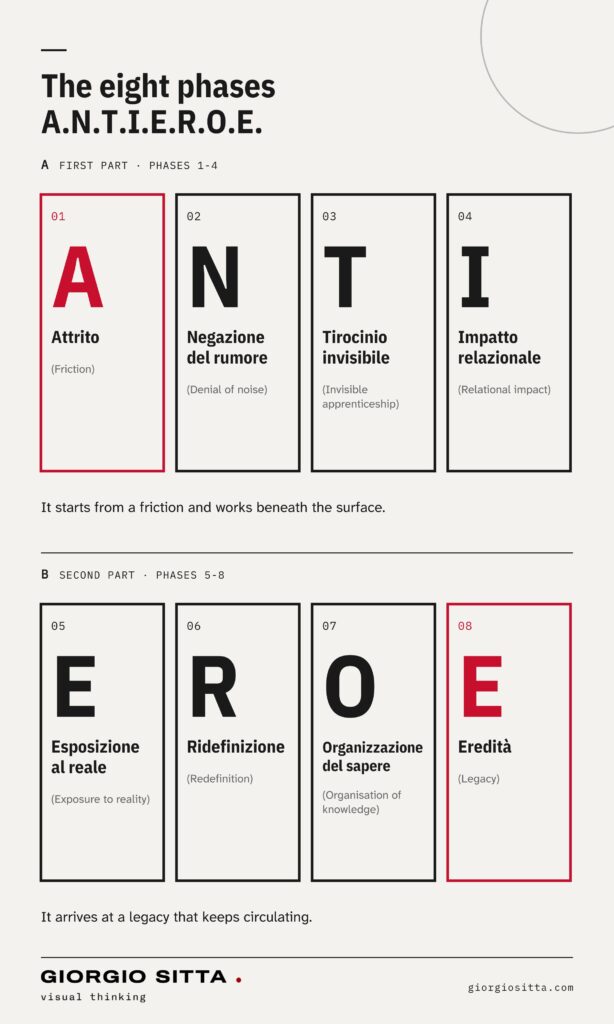
The eight A.N.T.I.E.R.O.E. phases are the theorisation of those alternative methods, put in line after years of practice: Attrito (Friction), Negazione del rumore (Denial of noise), Tirocinio invisibile (Invisible apprenticeship), Impatto relazionale (Relational impact), Esposizione al reale (Exposure to reality), Ridefinizione (Redefinition), Organizzazione del sapere (Organisation of knowledge) and Eredità (Legacy).
JOURNEY AND CAMMINO (PATH)
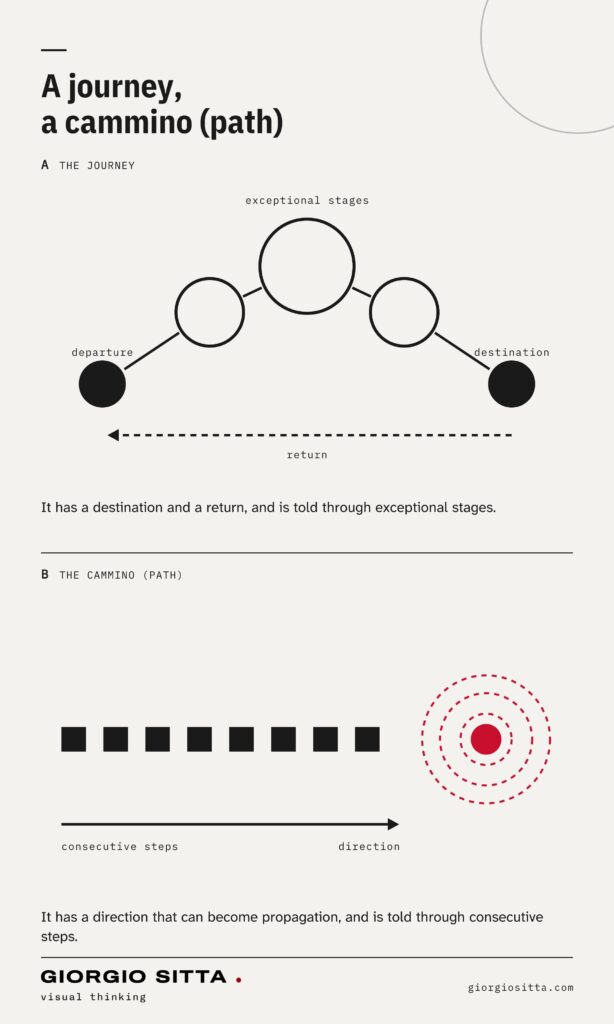
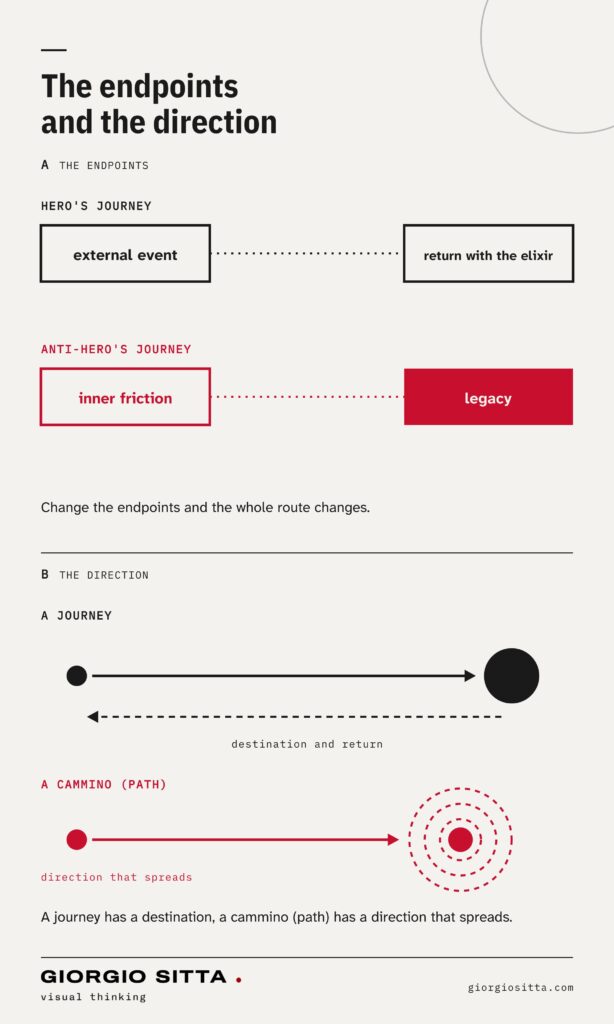
To those who know Vogler by heart I would like to show two differences. The first concerns the endpoints. The Hero’s Journey starts from a call and closes with the return, carrying the elixir. The cammino (path) starts from an inner friction and closes with a legacy, the value that keeps circulating when the author “is no longer in the room”. Change the endpoints and the whole route changes.
The second difference is conceptual. A journey has a destination and a return; a cammino (path) has a direction that can become propagation. A journey is told through exceptional stages, a cammino (path) through consecutive steps.
The differences, phase by phase, are collected on the page An alternative to the Hero’s Journey on antieroe.com.
IN BRIEF
- The Hero’s Journey starts from an external event; the Anti-Hero’s Journey from an inner friction.
- A journey closes with a return; a cammino (path) with a legacy.
- The eight A.N.T.I.E.R.O.E. phases do not come from a theory but from years of corrections to the heroic model.
- A journey has a destination; a cammino (path) has a direction that spreads.
RECOMMENDED LISTENING
Spotify playlist, seven tracks, in the playlist order:
- Nirvana, “Something in the Way” (1991)
- Alice in Chains, “Nutshell” (1994)
- Sonic Youth, “Teen Age Riot” (1988)
- Screaming Trees, “Nearly Lost You” (1992)
- Pearl Jam, “Release” (1991)
- Mad Season, “River of Deceit” (1995)
- Soundgarden, “Fell on Black Days” (1994)
ARTISTS
- Mark Lanegan, singer of Screaming Trees and Mad Season
- PJ Harvey, British singer-songwriter
- Sonic Youth, New York band
FILMS
- “The Conversation” (Francis Ford Coppola, 1974)
- “Paris, Texas” (Wim Wenders, 1984)
- “Chungking Express” (Wong Kar-wai, 1994)
BOOKS
- Christopher Vogler, The Writer’s Journey, a handbook on mythic structure for those who write fiction and film
- Joseph Campbell, The Hero with a Thousand Faces, scholar of mythology
- Douglas Coupland, Generation X, Canadian novel
Newsletter.
Ricevi ogni nuovo articolo per email.
Get every new article by email. New articles are also available in English.
Newsletter. Chi si iscrive alla newsletter fornisce il proprio indirizzo email per ricevere i nuovi articoli del blog. L'iscrizione e l'invio sono gestiti da Jetpack (Automattic Inc.), che tratta i dati come responsabile del trattamento. È possibile cancellarsi in qualsiasi momento con il link presente in ogni email. Dettagli nella privacy policy.
Newsletter. By subscribing, you provide your email address to receive new blog articles. Subscription and delivery are handled by Jetpack (Automattic Inc.), which processes the data as data processor. You can unsubscribe at any time using the link included in every email. Details in the privacy policy.